
By Emmanuel Buah
Date: October 28, 2026
Category: Football | Carabao Cup
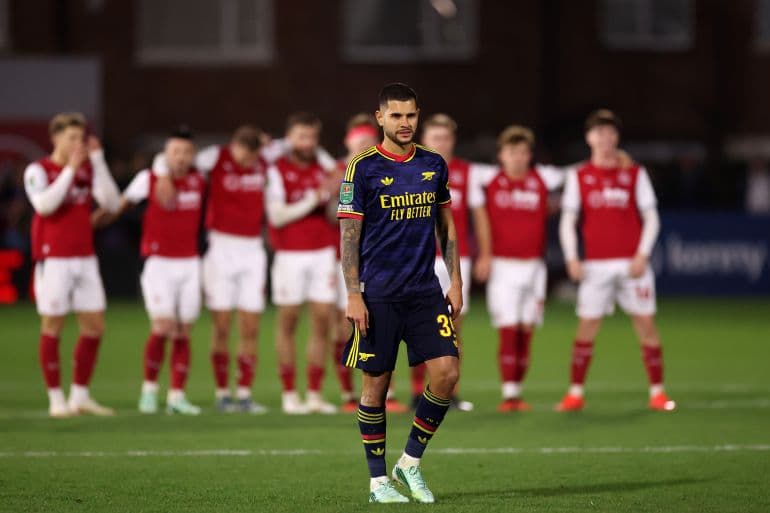
Fleetwood Town have produced one of the most remarkable upsets in recent English domestic football, eliminating reigning Premier League champions Arsenal from the Carabao Cup after winning 5–3 on penalties following a 1–1 draw at Highbury Stadium.
The League Two outfit, ranked 84 places below Arsenal in the English football pyramid, held their nerve against one of the country's strongest teams to secure a historic place in the competition's quarter-finals for the first time.
Aaron Loupalo-Bi gave Fleetwood an unexpected first-half lead before Arsenal striker Viktor Gyökeres restored parity shortly after the interval. Despite Arsenal dominating possession and creating numerous chances, the Gunners could not find a decisive second goal.
The tie eventually went to penalties after Arsenal teenager Max Dowman was sent off late in normal time. Fleetwood goalkeeper Jay Lynch then became the central figure of the evening, saving Bruno Guimarães's spot-kick before Conor Haughey converted the decisive penalty to spark jubilant celebrations among the home supporters.
For Fleetwood, it was a night that could define the club's history. For Arsenal, it was a painful reminder that possession, reputation and individual quality do not guarantee progression in knockout football.
Loupalo-Bi gives Fleetwood a dream start
Fleetwood entered the tie as overwhelming underdogs, but their approach showed little fear of the Premier League champions.
The opening stages were briefly disrupted when a drone above the stadium forced officials to suspend play. Once the match resumed, Arsenal enjoyed much of the possession but struggled to turn their control into clear-cut opportunities.
Fleetwood took advantage of that hesitation in the 21st minute.
Aaron Loupalo-Bi, playing on loan from Fulham, used his strength to get beyond young Arsenal defender Marli Salmon before finishing past goalkeeper Illan Meslier. The goal sent the home crowd into celebration and immediately changed the atmosphere inside the stadium.
The strike rewarded Fleetwood's direct approach and exposed Arsenal's vulnerability when defending transitions and physical challenges.
Arsenal responded by pushing forward, but Fleetwood remained organised. Their defenders protected the penalty area, contested aerial balls and limited the space available to Arsenal's attacking players.
Kai Havertz had an opportunity to equalise before the interval but could not convert his chance, allowing Fleetwood to reach half-time with a lead that few had predicted.
Gyökeres rescues Arsenal, but the Gunners waste their chances
Arsenal manager Mikel Arteta introduced Martin Ødegaard and Ben White at half-time in an attempt to improve the team's attacking rhythm.
The changes helped Arsenal move the ball with greater urgency, and the equaliser arrived in the 50th minute. Northern Ireland youngster Ceadach O'Neill delivered the ball into the penalty area, where Gyökeres bundled it home to make the score 1–1.
It was an important moment for the Swedish striker, who registered his first domestic goal of the campaign.
With the score level, Arsenal increased the pressure. Their technical superiority became more evident as they moved the ball around Fleetwood's defensive block and attempted to create openings through the middle and wide areas.
However, the visitors repeatedly failed to take their chances. Havertz missed promising opportunities, while Fleetwood's defenders continued throwing themselves into challenges to prevent Arsenal from taking the lead.
The match statistics reflected Arsenal's territorial dominance. The Gunners recorded approximately 78 per cent possession and 26 shots, compared with Fleetwood's three. Yet Arsenal managed only seven shots on target and scored just once.
That inability to convert dominance into goals ultimately proved decisive.
Max Dowman's dismissal adds to Arsenal's problems
Arsenal's task became more complicated late in the match when teenager Max Dowman received a red card following an incident involving Fleetwood's Harrison Neal.
The dismissal reduced Arsenal to ten players and added tension to an already difficult evening for the visitors. Dowman's reaction to the challenge became a major talking point, with the decision attracting debate over the circumstances of the incident.
Arsenal continued to search for a winner, but Fleetwood refused to surrender.
Goalkeeper Jay Lynch produced important late saves to deny Arsenal, including efforts involving Ben White and Ødegaard in stoppage time. Those interventions kept Fleetwood alive and carried the contest into the penalty shootout.
For the home side, every save reinforced the belief that an extraordinary result was possible.
Jay Lynch becomes Fleetwood's hero
The penalty shootout delivered the defining moment of the tie.
Both teams showed confidence from the spot, but Lynch made the crucial intervention by saving Bruno Guimarães's penalty for Arsenal.
The save shifted the pressure firmly onto the visitors and gave Fleetwood the opportunity to finish the job.
Conor Haughey stepped forward and converted the decisive penalty, sending the home crowd into delirium. Fleetwood won the shootout 5–3, completing a victory that few supporters would have imagined before kick-off.
Lynch's performance was especially significant because his saves had already helped Fleetwood survive Arsenal's late pressure in normal time. His composure during the shootout turned a difficult defensive assignment into one of the standout goalkeeping performances of the competition.
For Haughey, scoring the decisive kick provided a defining moment in his young career.
The result also demonstrated the importance of collective discipline. Fleetwood did not need to match Arsenal's possession or individual talent. They needed to remain organised, take their opportunity when it arrived and execute under pressure.
They did all three.
Why this defeat matters for Arsenal
Arsenal's elimination will raise questions about their finishing, squad management and ability to break down teams that defend deep.
Arteta selected a strong side, including Gyökeres and Havertz, while introducing experienced players such as Ødegaard as the game progressed. Nevertheless, Arsenal could not find the second goal needed to avoid penalties.
The defeat was not simply a case of a smaller club benefiting from luck. Fleetwood defended with determination, exploited an early opportunity and survived sustained pressure through their organisation and goalkeeper's performance.
Arsenal's red card complicated the closing stages, but the visitors had already struggled to make their attacking dominance count.
Arteta congratulated Fleetwood for reaching the next round while describing the outcome as a sad day for Arsenal. The challenge now is to ensure that the disappointment does not affect the team's performances in other competitions.
Although the Carabao Cup offers a route to silverware, Arsenal must also maintain their standards in the Premier League and their other campaigns. An early exit increases the scrutiny on the squad's depth and its response to pressure.
A historic night for Fleetwood Town
For Fleetwood, the victory carries significance far beyond the immediate result.
The club have spent years building their place in the English Football League, and a meeting with the reigning Premier League champions offered an opportunity to measure themselves against the country's elite.
Their success also places them among the most memorable underdogs in the competition's history. The English Football League noted that a reigning English league champion had previously been eliminated from the Carabao Cup by fourth-tier opposition only once, when Leeds United lost to Chester City in 1974–75.
Fleetwood have now joined that exclusive piece of cup history.
The result also brings practical benefits. Progress into the quarter-finals provides further exposure, an opportunity for additional revenue and the possibility of another major occasion for the club and its supporters.
Manager Matt Lawlor and his players will nevertheless need to return their attention to League Two football. The excitement of beating Arsenal cannot replace the importance of maintaining consistency in the league.
But for one unforgettable evening, Fleetwood's achievement belonged to the players, staff and supporters who believed they could challenge a team from a completely different level of the football pyramid.
What comes next?
Fleetwood will discover their Carabao Cup quarter-final opponents following the draw, with the club now only two victories away from a potential appearance in the final at Wembley.
Their next challenge will be to carry the confidence from this performance into their domestic campaign without allowing the celebrations to distract them.
Arsenal, meanwhile, must respond quickly. The defeat will be painful, but their season remains defined by the opportunities still available in other competitions.
The broader lesson from the match is familiar but powerful: knockout football rewards execution as much as possession. Arsenal controlled much of the ball, created more chances and entered the contest as clear favourites. Fleetwood were more decisive at the moments that mattered.
When the final penalty was converted, the difference between the two clubs' reputations no longer mattered.
Fleetwood Town had beaten the champions of England, and the Carabao Cup had delivered another night of football that will be remembered for years.


0 Comments